Twelve Months, One Chiller: A Forensic Account of the Plant That Quietly Drained a Service Charge
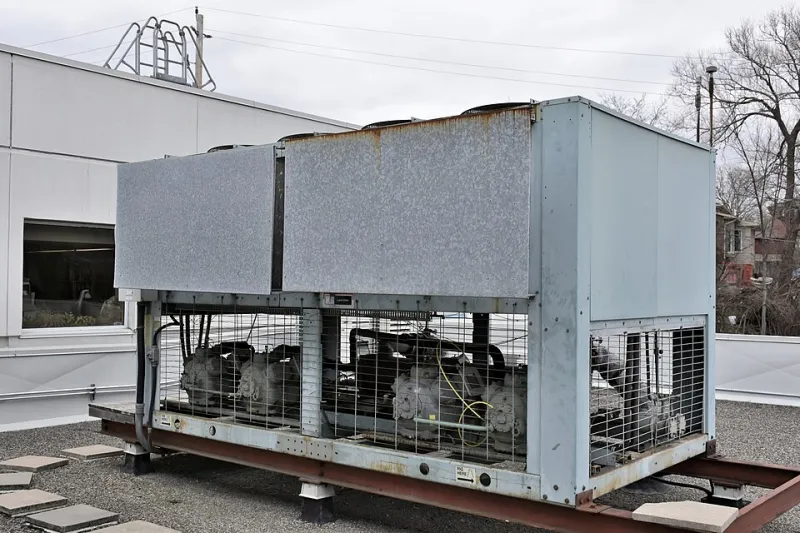
Photo: Saud, CC BY-SA 4.0, via Wikimedia Commons
Every service charge budget has a line item that nobody questions. On one business park just off the M4, that line was 'comfort cooling — plant maintenance and energy', and for three years it had crept upwards while nobody could say precisely why. When the new facilities manager arrived and pulled twelve months of data apart, the answer was sitting on the roof: a 22-year-old air-cooled chiller that had become, in her words, 'a subscription to somebody else's problems'.
This is her year, reconstructed from invoices, BMS logs and meter readings — and a framework you can apply to your own plant before the accounts close.
The Baseline Nobody Established
The chiller in question served two office buildings totalling around 4,800 square metres. Its original efficiency figures existed only in a manufacturer's brochure from 2003. No one had ever established a current baseline: energy consumption was buried within the landlords' half-hourly electricity supply, shared with lighting, lifts and small power, and the maintenance contract covered breakdowns — not performance.
That is the first trap. A chiller that is 'maintained' in the contractual sense can still be failing in the thermodynamic sense. Coils fouled by a decade of road dust, slightly undercharged refrigerant circuits, condenser fans running at fixed speed because a sensor failed years ago and was never replaced — none of these trigger a call-out. They simply nudge the kW per kW of cooling upwards, month after month.
Spring: The First Warning That Wasn't Heard
In April, tenants in the east building began reporting that their meeting rooms were warm by mid-afternoon. The response was the classic one: an engineer attended, cleaned the strainers, checked the controls and left. The call-out was logged, the complaint closed, and the invoice — £480 — was paid without scrutiny.
What the log didn't capture was the chiller's behaviour that afternoon. With degraded heat rejection, it had been tripping on high discharge pressure and restarting, cycling its way through the warmest hours rather than modulating steadily. The building stayed mostly comfortable. The electricity meter, meanwhile, recorded the equivalent of a chiller running hard with one hand tied behind its back.
Summer: The Peak That Cost Twice
By July, the pattern was established. On days above 26°C, the BMS trend data — which existed but was never routinely reviewed — showed the machine spending hours at full load while failing to hold setpoint in the west building. Portable units appeared in two lettings, hired at the tenant's insistence and recharged to the service charge as an 'agreed variation'.
The July electricity bill for the plant supply came in 41% higher than the same month two years earlier, adjusted for weather. Nobody flagged it, because nobody was comparing. Emergency call-outs in the same quarter totalled just under £3,200 — reasonable money to keep a temperamental asset alive, on the face of it. The hidden cost, in wasted energy and supplementary cooling, was roughly double that, and entirely invisible.
Autumn: Where Repair Overtakes Replacement
The decisive moment came in September, when the compressor on circuit two failed properly. The quote to replace it stood at £11,400, with a lead time of nine weeks and no warranty on the surrounding system, whose refrigerant was being phased down under F-Gas rules anyway. A replacement high-efficiency chiller, including crane, commissioning and disposal of the old unit, was quoted at £58,000.
Run the numbers as the new FM did. The old plant was consuming roughly 38,000 kWh a year more than a modern equivalent — around £11,000 annually at then-current rates, before maintenance premiums and breakdown risk. The compressor repair bought perhaps three seasons. Replacement paid for itself in energy alone within five years, qualified for enhanced capital allowances, and materially improved the building's EPC position ahead of tightening MEES expectations — a point not lost on the letting agents with two suites to market.
The repair was declined. The replacement was ordered in October, installed over a quiet weekend in November, and commissioned before the heating season made roof access miserable.
The Framework: Five Questions Before the Accounts Close
You do not need a forensic exercise to find your own compressor-that-ate-the-service-charge. You need an afternoon and five questions:
-
Can you isolate the plant's energy? If consumption is buried in a shared supply, sub-meter it. What cannot be measured cannot be defended to tenants.
-
What is the current efficiency, not the brochure efficiency? A competent contractor can calculate seasonal kW/kW from BMS trends. If yours can't, that itself is a finding.
-
What did call-outs actually cost last year, including everything? Parts, labour, tenant compensation, hired equipment, variations. Add it up honestly.
-
What is the refrigerant story? Systems running on high-GWP refrigerants face rising cost and shrinking support. A compressor failure on such a system is rarely a repair decision — it is a replacement decision wearing a repair's clothing.
-
What does the service charge say versus what do the tenants feel? Rising costs and rising complaints rarely arrive together in the same report. Cross-reference them.
The Quiet Conclusion
The business park's service charge for comfort cooling fell by just under a third in the first full year after replacement, and the tenant consultative meeting — often a gruelling affair — passed without a single cooling complaint. The old chiller went for scrap, its twenty-two years of service acknowledged with, reportedly, a cup of tea on the roof.
The lesson is not that chillers fail. It is that they fail slowly, in units of kilowatt-hours and closed complaints, and that the accounts only ever show the sum at the end. Ask the five questions now, while the answer is still a line item rather than a headline.