The Occupier's Audit: When Your Next Tenant Brings a Thermometer to the Viewing
Photo: Slaunger, CC BY-SA 3.0, via Wikimedia Commons
There was a time when a tenant's due diligence on a commercial lease extended to a measured survey, a schedule of condition and, if they were thorough, a look in the ceiling voids. That era is over. The occupiers now walking through your available floors — particularly the larger corporates bound by Science Based Targets and CSRD-aligned reporting — arrive with energy analysts in tow, and the first thing they ask to see is not the boardroom.
It is the plant room.
ESG Reporting Starts at the Meter
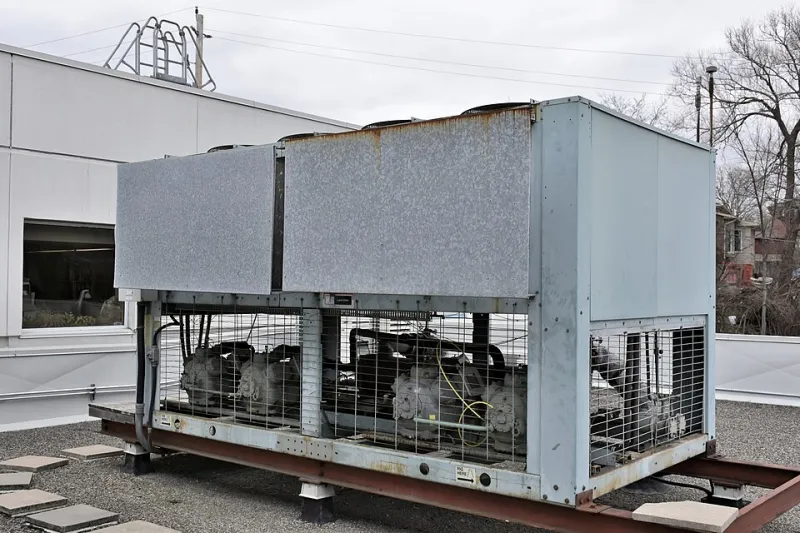
A corporate occupier's Scope 1 and 2 emissions are, in large part, the mechanical and electrical performance of the building they lease. When their sustainability team models the carbon liability of a ten-year commitment at a Reading business park or a Manchester office tower, they are not reading your marketing brochure. They are asking for sub-metering data, BMS trend logs, chiller seasonal efficiency figures and — increasingly — the maintenance history of every air handling unit on the roof.
The questions are specific and forensic. When was the AHU last deep-cleaned? Are the heating and cooling circuits separately metered? Has the BMS optimisation been reviewed in the past two years, or is the control strategy still whatever the original installer commissioned in 2009? A building that cannot answer these questions in writing is effectively answering them anyway.
What the Audits Are Finding
The findings from tenant-side assessments follow a familiar pattern, and it is rarely dramatic. Nobody expects a 1990s office block to run like a new speculative development. What undoes deals is the gap between the paperwork and the plant.
A building with an EPC rating of B on paper but a decade of deferred AHU maintenance tells an occupier everything they need to know about how the rest of the portfolio is run. Simultaneous heating and cooling visible in trend data. Weather compensation that was never commissioned properly after a controls upgrade. A heat pump installation whose performance has quietly degraded because filters were treated as an optional extra. None of these are headline defects, but together they signal a landlord who manages to the minimum compliance line — and occupiers with net zero commitments have learned that minimum compliance is their problem, not yours.
There is also the data access question. Occupiers increasingly request live or near-live metering feeds as a lease condition, both for their own reporting and to verify that service charges reflect actual consumption. A building with no sub-metering beyond the landlord's main intake forces that negotiation to happen blind, and blind negotiations rarely favour either party.
Turning the Plant Room Into an Asset
The obvious response — tidy up before viewings — is exactly the wrong one. Occupiers' technical teams can distinguish between a maintained building and a staged one, and a tenant who discovers a discrepancy after handover will price it into every future conversation, from rent review to break clause.
The better strategy is candour backed by evidence. A well-organised plant room with current service records, a legible maintenance log and honest metering data is, to a sustainability team, what a clean legal pack is to a solicitor. It demonstrates that the landlord's facilities operation is competent, and competence at the operational level is what keeps an occupier's reported emissions within their targets.
Practically, this means three things. First, get your maintenance records into a state where they can be shared without embarrassment — complete, chronological and honest about defects and their resolution. Second, invest in metering granularity; knowing where energy goes is the prerequisite for every conversation that follows. Third, commission an independent M&E condition review before the market does. The gap between what you think your plant is doing and what it is actually doing is where letting value quietly evaporates.
The Wider Market Shift
This is not a niche behaviour confined to FTSE 250 occupiers. As ESG obligations cascade through supply chains, mid-sized tenants are inheriting the reporting requirements of their larger clients, and they bring the same questions to a 10,000 sq ft suite in Slough that a bank brings to a City tower. The MEES minimums have already established that energy performance has a hard floor; tenant scrutiny establishes that it also has a market price above that floor.
For landlords and managing agents, the conclusion is uncomfortable but straightforward: your mechanical services operation is now part of your product. The tenant who reads the meter before signing is not being difficult. They are doing the arithmetic you should have done first — and the buildings that can hand over the numbers without flinching are the ones that will let first, and let at a premium.