After the Quota: Why a Failed Chiller Now Needs a Refrigerant Strategy, Not a Purchase Order
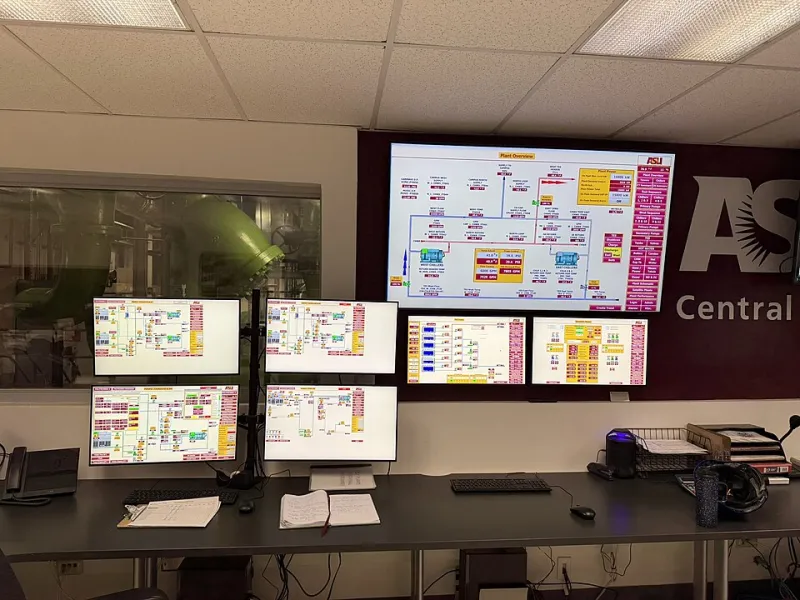
Photo: Rsparks3, CC0, via Wikimedia Commons
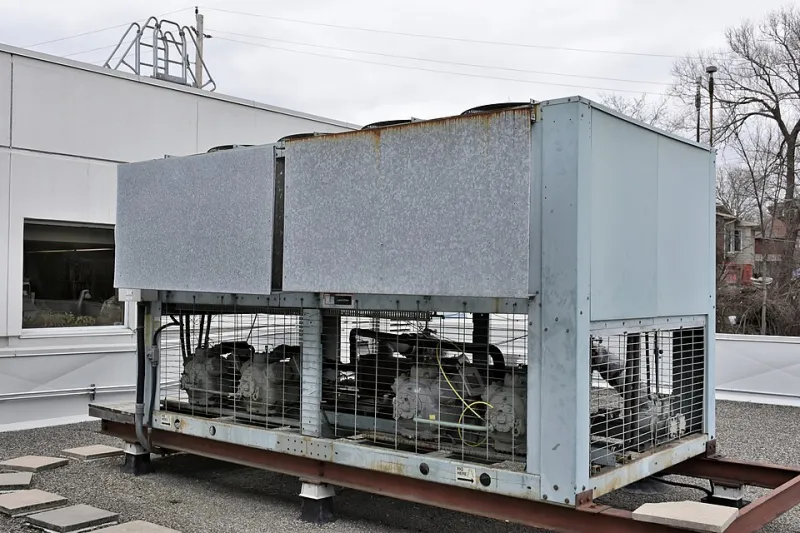
Chillers seldom fail at a convenient moment. They fail in July, on the Friday before a bank holiday, or during the week a tenant's fit-out contractor has booked the only available loading bay. In that moment the temptation is to treat the plant as a broken appliance: read the model number, order the same model, wait. For much of the last two decades that approach worked well enough. It is now becoming an expensive habit.
The reason is not one regulation but a direction of travel. The UK's F-Gas regime, retained and amended since departure from the EU, places a shrinking cap on the quantity of high-GWP hydrofluorocarbons that may be placed on the market. The cap is measured in carbon dioxide equivalent rather than kilograms, which means that as the permitted tonnage falls, the practical availability of familiar refrigerants falls faster than the headline percentage implies. Between 2024 and 2026 the UK quota sits at roughly 31 per cent of the baseline; from 2030 it drops to around 21 per cent. Those are not projections to be debated at a conference. They are already in force.
The quota is a schedule, not a warning
R410A, the workhorse of the past twenty years, carries a global warming potential of 2,088. R32 sits at around 675. R1234ze, increasingly specified for centrifugal and screw machines, is below 10. The arithmetic is unforgiving: a kilo of R410A consumes roughly two tonnes of CO2-equivalent quota, so a plant room holding 200 kg is responsible for more than 400 tonnes of CO2e before a single kilowatt of cooling has been delivered.
The practical consequences are already visible in the supply chain. Virgin R410A prices have become volatile, reclaimed stock is finite, and a blended refrigerant cannot simply be topped up with a different blend when a circuit develops a leak. Landlords who maintained a loose attitude to leak records are finding that the paperwork now matters as much as the gas.
What 'like-for-like' quietly assumes
A box-for-box replacement assumes four things, and each is now questionable.
First, that an identical unit is available on a sensible lead time. It frequently is not. Extended deliveries for lower-GWP equipment are now commonly quoted in the region of twenty to thirty weeks, and the order book tightens whenever a quota step approaches.
Second, that the existing plant room is suitable. It was designed around a non-flammable A1 refrigerant, with ventilation, detection and electrical zoning to match. R32 and R454B are classified A2L: lower flammability, not non-flammability. BS EN 378 and the guidance that supports it impose charge limits, ventilation requirements and, in some arrangements, gas detection and restricted access. A room that comfortably held 40 kg of R410A may not accept a comparable A2L charge without mitigation.
Third, that the electrical and hydraulic infrastructure is adequate. Newer machines often want different flow rates, different pressure drops, different starting currents and different controls integration. A straight swap can become a pump replacement, a starter replacement and a BMS upgrade in sequence.
Fourth, and most often overlooked, that the decision is purely financial. It is not. It is a compliance decision with a twenty-year tail.
The safety case for reading the room first
A2L refrigerants are manageable; they are used safely across Europe and the UK. But they demand a documented risk assessment rather than an assumption. The questions are practical: what is the room volume, what is the worst-case release concentration, where are the ignition sources, how is the space ventilated in normal and fault conditions, who enters it, and how is that access controlled?
Where a plant room sits below ground, adjoins a loading bay or shares a wall with a stair core, the answers shape the specification. Occasionally the correct conclusion is that the room cannot take the charge and the unit must be split, relocated or derated. Discovering that after the order is placed is an expensive way to learn.
What a refrigerant strategy actually contains
A strategy need not be a fifty-page document. It does need to be honest.
- A refrigerant register: every circuit, its charge, its GWP and its CO2e, with leak history attached.
- A condition and remaining-life assessment for each chiller, not a single building-wide average.
- An options appraisal covering repair, lower-GWP replacement, heat pump conversion and, where appropriate, connection to a district or shared loop.
- A plant room safety review addressing charge limits, ventilation, detection and access.
- A capital profile aligned to the quota steps in 2027 and 2030, so that replacement is planned rather than reactive.
- A recovery and disposal route, with waste transfer notes retained alongside the O&M file.
The order of operations
When a chiller fails, the first call should be to an F-Gas certified engineer able to survey the circuit and the room, not to a supplier able to quote a model number. The second call should be to whoever holds the maintenance records, because a leak-prone machine with three interventions in two years is telling you something a datasheet cannot.
It is also worth remembering the R22 precedent. When that supply ended, plant that had been perfectly serviceable became scrap metal on a date decided elsewhere. The refrigerants in today's plant rooms will follow a similar curve, at a pace set by the quota rather than by the building.
The chiller that fails next summer will not care about any of this. The landlord who has already written the strategy will.