Topping Up Is Not a Strategy: The Chiller Repair-or-Replace Decision in 2026
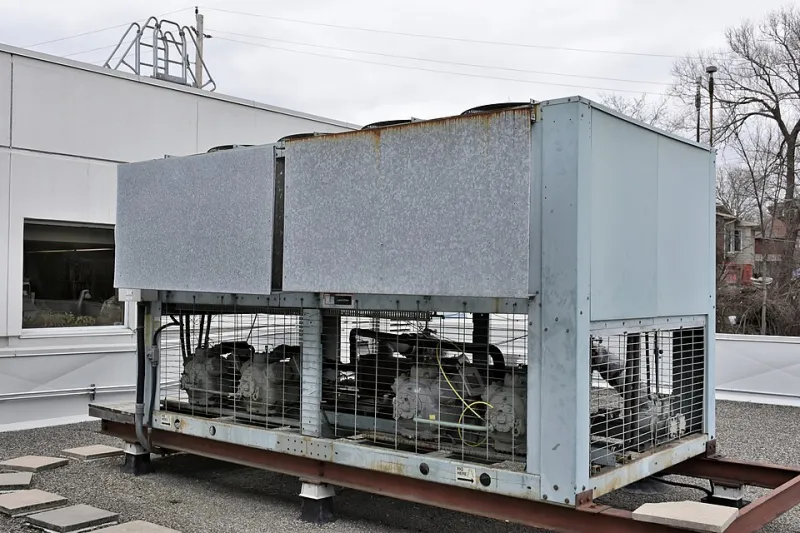
Photo: Saud, CC BY-SA 4.0, via Wikimedia Commons
A chiller serving a 1990s business park on the M4 corridor has developed a leak on its evaporator circuit. The service engineer quotes £9,400 to replace the coil and recharge the system. The finance director, looking at a plant list that shows the machine is nineteen years old, asks the obvious question: is a new chiller at £85,000 the better buy?
In 2026 that question is decided less by the coil than by the gas inside it.
What has changed in the refrigerant market
The UK F-Gas regime, retained from the EU regulation and administered nationally since, places a quota on the supply of virgin hydrofluorocarbons. The quota steps down in stages toward 2030, and each step tightens the gap between what the market wants and what may lawfully be placed on it. The result is a price signal that has been rising for several years and shows no sign of softening.
The figures matter when you are standing in a plant room. R410A carries a global warming potential of 2,088. R407C sits at 1,774, R134a at 1,430 and R404A at 3,922. Lower-GWP alternatives are available — R32 at 675, R454B at around 466, R513A at 631 — but most are mildly flammable, which brings a DSEAR assessment, plant room ventilation and refrigerant detection into the conversation. Retrofitting a gas is not a like-for-like swap.
Reclaimed refrigerant remains lawful and is often the pragmatic route for maintaining an existing machine. Availability, however, is finite and priced accordingly. A top-up that cost a few hundred pounds a decade ago can now run into four figures, and the quotation will frequently be valid for seven days rather than thirty.
The compliance traps in a top-up
Leak management is where well-run estates and badly run estates diverge. The obligations are not complicated, but they are recorded, and the records travel with the building.
- Leak checks are required at frequencies set by the charge in tonnes of CO2 equivalent, moving from twelve months to six to three as the threshold rises. A permanently monitored system can qualify for extended intervals.
- Where a leak is identified, it must be repaired within a defined period, and the repair verified by a follow-up check. Repeatedly topping up a leaking circuit without addressing the cause is not a maintenance strategy; it is a documented failure to comply.
- Work must be carried out by a registered business using certificated engineers, with refrigerant recovered rather than vented.
- Equipment must be labelled, and records of gas handled, recovered and added must be retained. These records are increasingly requested during dilapidations, lease renewals and insurer surveys.
None of this is onerous for a portfolio with a competent contractor and a single register. It becomes expensive when the file is incomplete and the tenant's solicitor asks for five years of history.
The arithmetic: repair versus replace
Take a nominal 300 kW air-cooled chiller running 1,400 equivalent full-load hours a year at 26 pence per kilowatt hour. An ageing machine with a seasonal efficiency equivalent to a coefficient of performance of 2.6 will consume around 161,500 kWh, or roughly £42,000 of electricity. A modern replacement at 3.8 reduces that to about 110,500 kWh, or £28,700 — a saving in the region of £13,000 a year before anything else is counted.
Add the items that do not appear in the energy model. A leaking circuit may lose 10 to 15 kilograms of R410A a year; at current virgin prices that alone can exceed £1,000, and the figure is moving upward. Add the labour, the downtime, the risk of a failure in July when the building is fully let, and the absence of spare parts for a machine that left production a decade ago. Then add the capital cost of the replacement, typically £85,000 to £110,000 installed for a unit of this size, and the payback on energy alone lands somewhere between five and seven years — shorter where heat recovery, free cooling or part-load performance can be exploited.
Where the machine is eight to ten years old and holds a mid-GWP gas with no leak history, the calculation points the other way. Repair, maintain and plan. The mistake is to let the decision be made for you by a failure in peak season.
Questions to ask before signing another service contract
- Which refrigerant does the machine hold, and what is its GWP and current charge?
- Is refrigerant included in the contract price, and at what rate — fixed, capped or at market?
- What is the leak history of this asset, in kilograms and in pounds, over the last three years?
- Does the contractor supply reclaimed gas, and can they evidence its provenance?
- What leak detection is fitted, and does it qualify us for an extended inspection interval?
- What is the response time, and does it hold at weekends in August?
- Who owns the end-of-life plan, and what evidence of recovery and destruction will we receive?
- Are replacement options being priced annually, so that the capital decision is ready before it is forced?
The decision framework
A chiller is not a boiler. It cannot be nursed indefinitely with a spanner and goodwill. If the machine is more than fifteen years old, holds a high-GWP gas, has leaked more than once in three years and is running at an efficiency the building's EPC can no longer tolerate, the case for replacement is made on compliance and energy together. If it is younger, sound and well documented, repair is the better use of capital — provided the replacement is planned and budgeted rather than discovered.
The worst outcome is the middle one: three years of top-ups, an incomplete F-Gas register and a failure on the hottest week of the year. That is not a plant problem. It is a planning problem, and it is entirely avoidable.