It Passed at Handover: The Rooftop Noise Problem That Maintenance Quietly Created
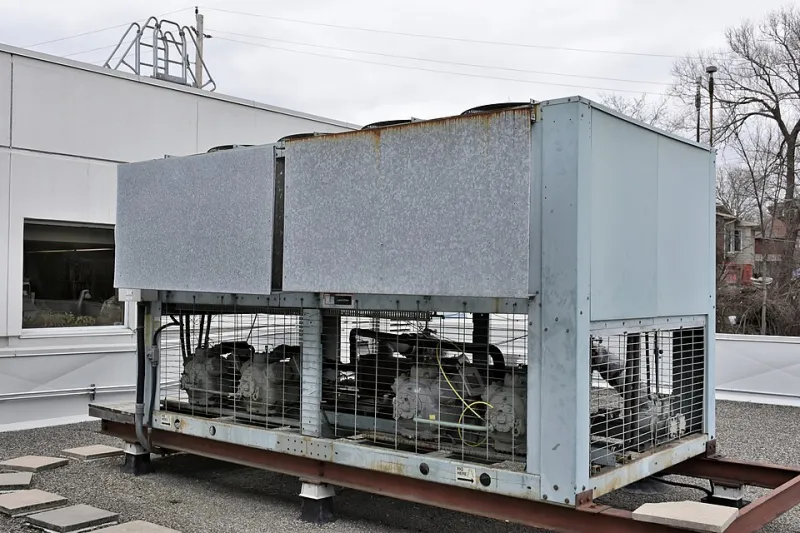
Photo: Kgbo, CC BY-SA 4.0, via Wikimedia Commons
There is a sentence that appears in almost every response to a noise complaint, and it is almost always useless: it passed when it was installed.
Of course it did. It was assessed against a background level measured before the building was occupied, at a design stage when the plant was new, the attenuators intact and the mounting arrangements exactly as drawn. None of those conditions is permanent, and neither is the compliance that depended on them.
Planning Consent Is a Snapshot, Not a Guarantee
A planning condition on plant noise typically sets a limit — often expressed as a rating level relative to background under BS 4142, sometimes as a simple absolute level at the nearest noise-sensitive premises. The applicant demonstrates compliance at design stage, the condition is discharged, the plant is installed, and the matter is considered closed.
The legal reality is otherwise. Planning compliance is assessed at a point in time. Statutory nuisance under the Environmental Protection Act 1990 is assessed on the effect on the neighbour now, and a local authority investigating a complaint is not bound by the fact that a consultant once produced a favourable report. If the plant is causing a nuisance today, the history of the consent is background context, not a defence.
How Rooftop Plant Grows Louder Without Anyone Touching It
Noise increases gradually, which is precisely why it goes unnoticed by the people responsible for the building and is noticed immediately by the people living next to it.
Attenuation degrades. Acoustic louvres collect debris and lose free area; perforated linings corrode; splitters accumulate dirt and, in the case of some older absorptive materials, deteriorate internally. Each of these reduces insertion loss, and the loss is usually in the mid to high frequencies where tonality is most noticeable.
Isolators fail. Rubber anti-vibration mounts perish, springs corrode, and the replacement fitted in a hurry during a breakdown is frequently a standard mount rather than the specified one. A rigidly connected refrigerant pipe or duct can short-circuit an entire isolation system, transmitting vibration directly into the structure.
Bearings and drives wear. A worn fan bearing or a misaligned belt adds a tonal component that did not exist at commissioning. Tonality attracts a penalty in a BS 4142 assessment, so a modest increase in overall level can produce a disproportionate increase in rating level.
Plant gets added. A communications room needs additional cooling. A kitchen extract is upgraded. Aerial and rooftop equipment accumulates. Each addition is assessed on its own merits, rarely in combination with what is already there.
Operating hours change. A unit designed for daytime duty is put on a 24-hour schedule to serve a tenant requirement, and the night-time assessment — where background levels are lowest and the margin is tightest — is never revisited.
What an Acoustic Audit Actually Covers
An audit is not a single reading taken at the boundary. It is a structured exercise, and it should begin with the original documentation: the planning condition, the noise assessment submitted in support, the manufacturer sound power data for each unit, and the attenuation specification.
From there, the work is measurement and attribution. Survey positions are set at the nearest noise-sensitive premises rather than at the site boundary, because the boundary is rarely where the complaint originates. Measurements are taken over sufficient periods in both day and night conditions, with the plant operating normally.
Attribution matters as much as measurement. Switching plant in sequence allows the contribution of each source to be separated, which in turn prevents the wrong unit being silenced. Octave band data allows tonality and low-frequency content to be identified — the latter being the component most likely to travel into a building and least likely to be addressed by a simple barrier.
The physical inspection runs alongside. Are the acoustic louvres clear? Are the flexible connectors still flexible? Are the anti-vibration mounts the specified type, and is anything bridging them? Has additional plant been installed since the original assessment, and was it included in any subsequent calculation?
The output should be a comparison: current measured rating level against the planning condition and against the original design assumptions, with the causes of any divergence identified.
Pre-empting the Complaint
Most noise complaints arrive through the local authority, which means the first communication a building owner receives is a formal one. That is a poor position from which to negotiate, because the investigation is now on someone else's timetable.
A better sequence is to commission the audit before the complaint, keep the report, and act on its findings. Where the building sits close to residential premises, an approach to neighbours before the winter plant schedule — a letter with a contact number, a commitment to investigate any concern — costs very little and changes the character of any future conversation entirely.
It is also worth aligning the acoustic audit with the maintenance regime rather than treating it as a one-off. Isolator condition, louvre cleanliness and bearing noise are all things an engineer can observe on a routine visit. If the maintenance schedule does not currently ask anyone to look, nobody will.
The Defence That Does Not Hold
The building services industry has become considerably better at documenting design intent. It has not become notably better at checking whether the building still matches that intent five winters later.
A planning consent is a record of what was agreed. It is not a warranty of what exists now. The only defensible position, when a neighbour complains about the condenser above their bedroom, is a recent measurement, a clear record of the plant as it stands, and evidence that the building has been maintained to the standard the consent assumed.