A Generator That Starts Is Not a Generator That Works: Five Checks Worth Doing This Winter
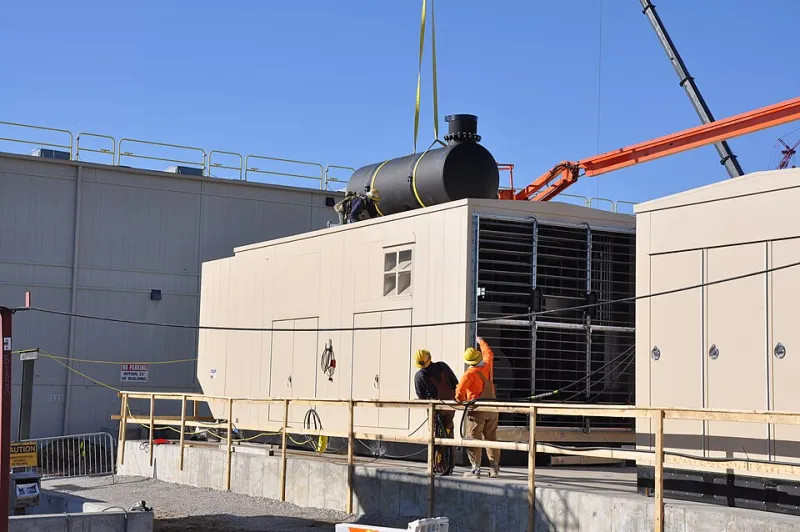
Photo: PEO ACWA, CC BY 2.0, via Wikimedia Commons
The weekly thirty-minute run is the most common generator test in the United Kingdom, and among the least informative. It proves that the starter turns, the alternator excites and the fuel solenoid opens. It does not prove that the set can carry the building, and it does not prove that it will still be able to in February.
Treat generator testing as a small project with a scope, acceptance criteria and an evidence file, and the gaps become obvious very quickly.
The limits of a no-load run
A diesel engine running at light load for half an hour does not reach operating temperature. Unburnt fuel accumulates in the exhaust and on the cylinder walls, a condition known as wet stacking. Over months it glazes bores, fouls injectors and reduces the set's ability to accept a sudden load. The generator sounds healthy because it is doing nothing.
Worse, the practice creates confidence without evidence. A facilities team that has watched the set start every Monday for three years will be genuinely surprised when it trips on transfer. The tests below are designed to remove that surprise.
Test one: can it actually carry load?
A load bank is the only way to answer this question without taking the building off supply. The unit is connected to a temporary resistive or resistive-reactive bank and run at 50 to 80 per cent of rated output for two to four hours, with step changes to observe voltage and frequency recovery.
What it reveals: wet stacking, cooling deficiencies, fuel starvation under demand, governor instability and exhaust restrictions. What it proves: that the set will still be capable when the mains fails at 18:00 on a Friday.
Annual load-bank testing is a sensible baseline for most commercial sites; data centres and life-safety applications often justify a six-monthly regime. Hire costs are modest against the cost of a failed transfer, and the test report is exactly the kind of evidence insurers and tenants now ask to see.
Test two: is the fuel fit to burn?
Diesel degrades. Modern road-grade fuel contains a bio-component that is hygroscopic, and water in a storage tank encourages microbial growth, sludge and filter blocking. A generator that runs perfectly on a test can fail within minutes on load when the filters load up with contamination.
Fuel polishing, filtration and periodic laboratory testing for water content, microbial activity and particulate cleanliness should be on the schedule. Tank inspection, bunding and the oil storage regulations apply here too, and the paperwork is as important as the sample. Fuel rotation and additive treatment are cheap; a tank of unusable diesel discovered during a power cut is not.
Test three: will the batteries crank it in February?
Starter batteries fail gradually and then completely. Voltage checks alone are insufficient. A proper regime covers charger output and float voltage, a load or conductance test, terminal condition and torque, electrolyte levels where applicable, and a replacement policy based on age rather than on symptoms — four to five years is a common working assumption.
Remember that the generator battery and any uninterruptible power supply batteries are separate systems with separate failure modes. A healthy engine battery tells you nothing about the UPS that is meant to bridge the gap before the set accepts load.
Test four: does the changeover actually transfer?
The automatic transfer switch is often the weakest link precisely because it is rarely exercised under real load. Testing should record the actual break duration, confirm that the UPS can ride through it, verify the interlocks and neutral switching arrangements, and demonstrate a clean return to mains.
A simulated transfer using a signal is not the same as a transfer into a live load. Where the building can tolerate it, a planned full transfer once or twice a year — outside core hours, with the tenant informed — provides evidence that no amount of desktop review can match. Record the timings and compare them with the previous test. A break that has drifted from eight seconds to twenty-two is telling you something.
Test five: what is coming out of the exhaust?
Exhaust condition is a diagnostic window. Black smoke under load suggests incomplete combustion or an overloaded set. Blue smoke points to oil consumption. White smoke may indicate coolant or unburnt fuel. Beyond colour, the survey should cover back pressure against the manufacturer's limit, insulation condition, flexible connections, silencer integrity, and the flue termination relative to openings and ventilation intakes.
Inside the plant room, carbon monoxide detection and adequate ventilation are not optional extras. Acoustically enclosed sets in small rooms derate quickly when the ambient temperature climbs in summer, and a machine rated at 500 kVA on the datasheet may deliver considerably less on the day it is needed.
Turning the tests into evidence
The regulatory backdrop is not exotic: the Electricity at Work Regulations 1989 require maintenance of electrical systems to prevent danger, the Provision and Use of Work Equipment Regulations 1998 apply to the plant itself, and the COSHH Regulations cover diesel and exhaust exposure. Environmental rules govern fuel storage and bunding.
What turns compliance into assurance is the file. Monthly no-load runs with start time, run time and any observations. Annual load-bank certificates. Fuel test results and polishing records. Battery test logs with replacement dates. Transfer test timings. Manufacturer-scheduled servicing with parts used. That pack supports the insurer's questions, the tenant's due diligence and the business continuity plan in equal measure.
Five questions for the next service visit
- When was the set last tested on load, and what was the maximum percentage of rating achieved?
- What were the fuel test results, and when was the tank last inspected and polished?
- What are the battery ages and conductance readings, and when is replacement due?
- What was the measured changeover time at the last transfer, and how does it compare with the UPS ride-through?
- What was the exhaust back pressure, and is it within the manufacturer's limit?
If the answers are not immediately available, the generator is not being maintained; it is being started. Those are different activities, and only one of them keeps the building running.