What the Building Tells You at 4am: A Case for the Out-of-Hours Audit

Photo: Staff Sgt. Elora J. McCutcheon, Public domain, via Wikimedia Commons
At twenty past four on a February morning, a city-centre office block in Bristol is doing something curious: it is working hard for nobody. The heating is holding a boardroom on the third floor at 22 degrees, even though the last meeting there finished nine hours ago. Two floors of luminaires are burning above empty desks. Somewhere in the riser, an air handling unit hums away at a duty it has no reason to perform.
Nothing is broken. Every component would pass a daytime inspection with a clean bill of health. And yet, month after month, this quiet midnight effort appears on the electricity and gas invoices as a line item nobody questions.
The Building Behaves When You're Watching
There is a simple reason out-of-hours inspections find things daytime audits never will: during working hours, a building is performing for an audience. Occupiers are present, controls are being overridden by the people who feel cold, and the BMS is running its scheduled programme. Everything looks intentional.
After midnight, the mask slips. What remains is the building's true baseline — the loads that never switch off, the zones that never quite reach setback, the equipment that was left in hand rather than auto after a maintenance visit in 2019. Our engineers call it the honesty audit, and it routinely uncovers between 10 and 20 per cent of a building's energy spend.
What a Nocturnal Walk-Through Actually Finds
The findings fall into a handful of familiar categories, none of which require sophisticated monitoring to detect.
Lighting left to its own devices. Occupancy sensors that have been disabled or defeated — taped over, angled at the ceiling, or simply failed — leave entire floors illuminated for nobody. Emergency lighting on permanent charge is one thing; a full grid of office luminaires at 3am is another entirely.
Heating fighting an empty room. Time clocks drifted out of alignment with actual occupancy, frost thermostats set so conservatively that setback never happens, and fan convectors running in zones that have been vacant since the tenant on the second floor handed back their lease.
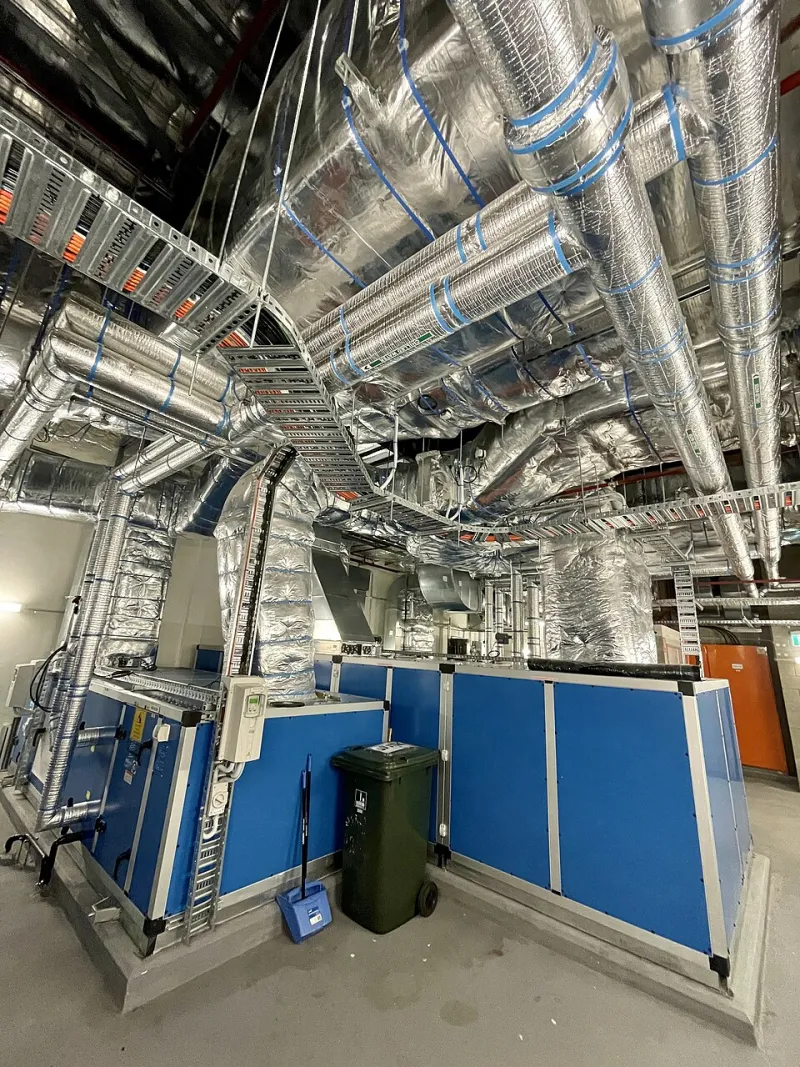
The noises nobody has learned to ignore. Every building has a resident population of sounds that daytime staff have filtered out. A nocturnal visitor hears them fresh: the solenoid valve chattering every ninety seconds, the pump running against a closed valve, the AHU heating an empty stairwell. Each one is a small, continuous cost with a straightforward fix.
Controls in hand. Perhaps the most common finding of all. A plant item switched to manual during a service visit and never returned to auto will run indefinitely, invisible to the BMS and unremarked upon by anyone. Daylight never reveals it; 4am does, immediately.
Why Once a Year Is the Minimum
The case for scheduling at least one out-of-hours audit annually rests on compounding. Each finding on its own is trivial — a lighting circuit here, a stray time clock there. Together, and left uncorrected for years, they become the sort of standing waste that inflates service charges, drags down EPC ratings, and complicates MEES compliance when a lease event forces the issue.
There is also a safety dimension. Night-time is when a building's emergency provisions are actually relied upon, or not. An audit conducted in darkness verifies that escape routes are genuinely illuminated, that external lighting covers the car park an early-shift colleague will cross at 5am, and that fire doors in the quietest corners of the building close and latch as designed.
A Practical Framework
A useful night audit need not be elaborate. We suggest a structured walk covering:
- A full floor-by-floor lighting survey, noting every luminaire burning without an occupant within thirty metres
- A zone-by-zone temperature check, comparing actual readings against the scheduled setback for each area
- A listening tour of plant rooms, risers and roof plant, logging every piece of equipment that is running and asking why
- A verification pass on the BMS, confirming that every item found in hand or overridden should genuinely be so
- An emergency lighting and external lighting check, conducted in genuine darkness rather than simulated
Findings should be logged with locations and photographs, costed where possible, and — critically — assigned an owner and a deadline. An audit report that sits in a shared drive is a document; an audit report with actions is a saving.
The Cheapest Energy Measure You'll Buy This Year
There is a temptation, in the race toward net zero, to reach for the photovoltaic array and the heat pump before addressing the fundamentals. But no amount of renewable generation excuses heating an empty boardroom at four in the morning.
The out-of-hours audit is among the lowest-cost interventions available to a UK facilities manager, and among the highest-yield. It requires no capital, no planning permission and no procurement exercise — only a torch, a thermometer, and a willingness to see the building as it actually is when nobody is looking.
We would go further: make it an annual fixture, rotate the engineer who conducts it so fresh eyes stay fresh, and report the findings to occupiers. Transparency about midnight running costs has a way of concentrating minds in the daytime too.